
Eurovelo 9 cycling guides and maps
EuroVelo 9 – From the Baltic Sea to the Adriatic Sea
Eurovelo 9 is a 2,050 km European cycling route that connects the Baltic Sea to the Adriatic Sea. Nicknamed the Amber Road, this cycle route crosses contrasting landscapes, from major capitals to the Alps, passing through Moravian vineyards and Croatian beaches. An authentic cycling journey combining nature and culture.
EuroVelo 9, a cycle route in the heart of Central Europe
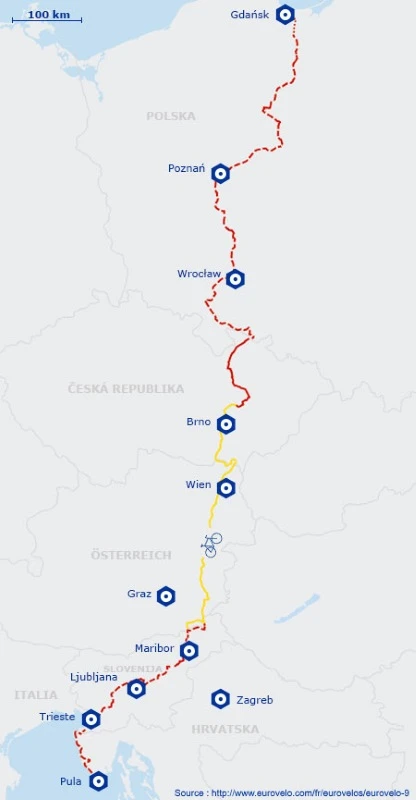
EuroVelo 9 begins in Gdańsk, Poland, on the shores of the Baltic Sea, and ends in Pula, Croatia, on the Adriatic Sea. It crosses six countries, following a north-south route across Central Europe :
- Czechia
- Austria
- Slovenia
- Italy
EuroVelo 9 offers several levels of difficulty, depending on the country:
- In Poland : The route has been decided but is still poorly marked. You’ll need maps or a GPS.
- In the Czech Republic : Progressive signage up to Brno, with beautiful sections in Moravia.
- In Austria and Slovenia : The heart of the route, between Brno and Maribor, is very well-developed, with quality cycling infrastructure, accommodations, and clear signage.
- In Italy : The section around Trieste is short but demanding, with occasionally busy roads. Approach with caution.
- In Croatia : The arrival on the Istrian coast at Pula offers splendid panoramas, but the route is still lacking signage. An up-to-date EuroVelo map is essential.
In short, the Eurovelo 9 difficulty : Easy to intermediate between Brno and Maribor, more demanding in the north and in Istria. Generally accessible to regular cyclists, with a well-equipped bike.
The must-sees on the EV9
EuroVelo 9 crosses regions with diverse and often little-known heritage. Here are some of the most iconic sites and stages :
- Gdańsk in Poland, a Hanseatic city with a rich maritime past.
- Wrocław in Poland, canals, bridges, Gothic architecture.
- Brno in the Czech Republic, the capital of Moravia, with its modernist heritage.
- Vienna in Austria, imperial palaces, museums, and exemplary cycle paths.
- Graz in Austria, a UNESCO World Heritage Site blending tradition and modernity.
- Maribor in Slovenia, the Slovenian wine capital, surrounded by hills.
- Ljubljana, a green capital, pleasant to explore by bike.
- Trieste in Italy, a former port of the Austro-Hungarian Empire, a cultural and architectural crossroads between Central Europe and the Mediterranean.
- Pula in Croatia, a city with a southern atmosphere, famous for its Roman arena, turquoise coves, and sun-drenched stone streets.
Traveling on the Eurovelo9 also means discovering rich local cultures, tasting regional specialties, and meeting welcoming locals. It’s Europe through its back roads.
Routes connected to EuroVelo 9
Several EuroVelo routes intersect or connect with EuroVelo 9:
- EuroVelo 6 – from the Atlantic to the Black Sea : Reachable from Vienna or Bratislava, the EV6 crosses Europe from west to east along the Loire, the Rhine and the Danube.
- EuroVelo 13 – Iron Curtain Cycle Route : It runs alongside the EV9 in Austria and Slovenia, following the former Cold War border.
- EuroVelo 8 – Mediterranean Route : Runs along the Mediterranean from Spain to Cyprus for 7,500 km. In Istria, a connection is possible to go up the Adriatic coast.
These connections allow you to extend your adventure or create a tailor-made cycling loop to suit your pace and interests. For even more route ideas, we invite you to visit our guides and maps of Europe.