

Hiking guides and maps on the GR®654
GR®654 – Vézelay Route / Via Lemovicensis
The GR® 654, also known as the Vézelay Way or Via Lemovicensis, invites hikers and pilgrims to follow a legendary route. It’s not just a trail. It’s a true adventure spanning nearly 1,750 kilometers. It connects Belgium to Santiago de Compostela, Spain. The route is beautiful, varied, and steeped in history. It’s perfect for an unforgettable experience, following in the footsteps of ancient pilgrims.
GR®654, The historic route to Compostela
The Via Lemovicensis, or Vézelay Way, is one of the historic routes taken by pilgrims since the Middle Ages to reach the holy city of Santiago de Compostela in Spain. Historically, Vézelay has always been a popular starting point for pilgrimages in Europe, thanks to the fame of its basilica dedicated to Saint Mary Magdalene, a true architectural gem listed as a UNESCO World Heritage Site.
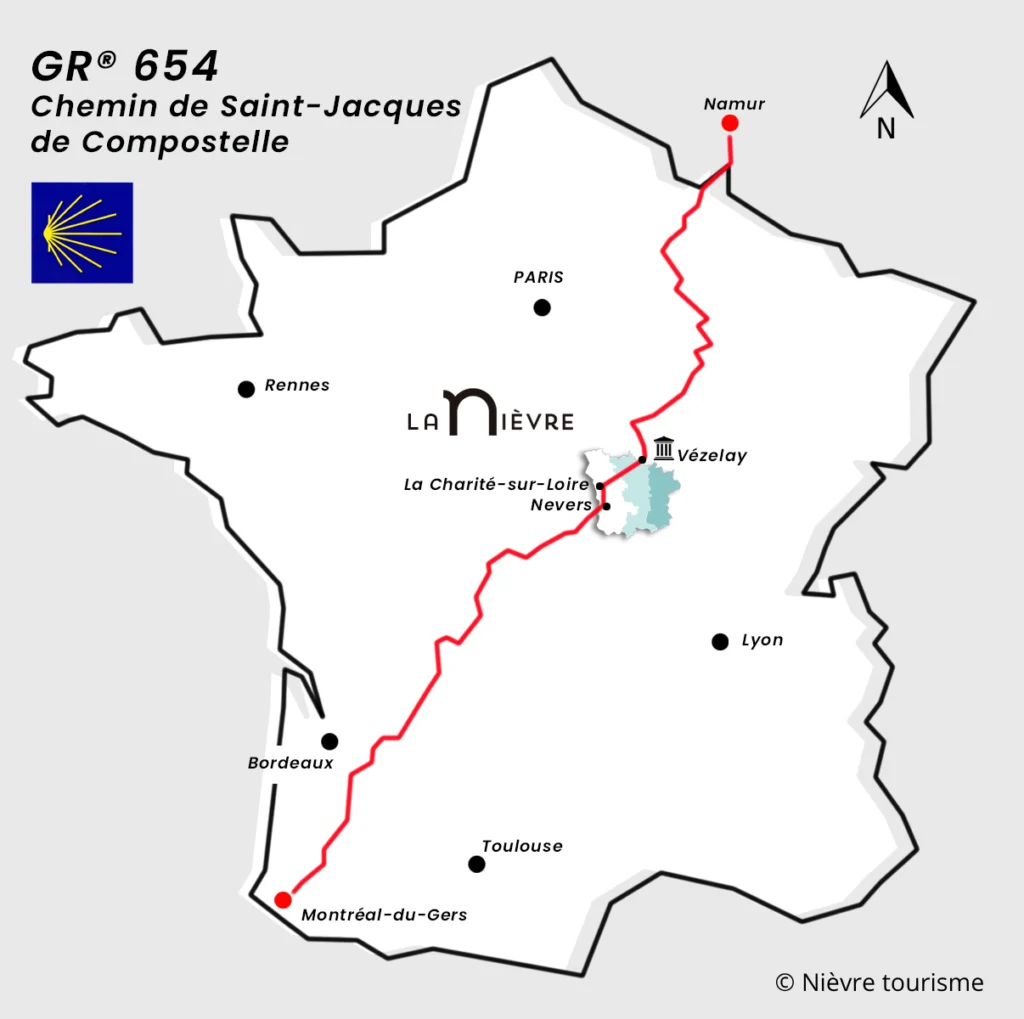
The GR® 654 begins in Namur, Belgium. It crosses France to Montréal-du-Gers. There, it joins the famous GR® 65 to continue to Compostela. Over 1,750 kilometers, the trail offers varied landscapes. You’ll see the Meuse and Marne rivers, the forests of the Ardennes, and then the vineyards of Champagne and Burgundy. In the past, many German and Flemish pilgrims passed through this area. Today, it’s an essential part of our heritage.
The route generally follows the Meuse and Marne rivers, crossing the forested landscapes of the Ardennes before winding through the heart of the Champagne and Burgundy vineyards. Historically frequented by German and Flemish pilgrims, the Vézelay route is today an essential trail of European spiritual and cultural heritage.
The main stages of the GR® 654 : it begins in Namur, Belgium, then crosses France via La Charité-sur-Loire, Nevers, Vézelay (the famous “eternal hill”), Bourges, Limoges (with its Saint-Martial Abbey), Périgueux, Mont-de-Marsan, and finally Montréal-du-Gers. At each stop, you’ll discover varied landscapes and experience unique experiences, immersing you in the spirit of the pilgrims.
What to see on the GR®654?
The Via Lemovicensis crosses regions rich in riches. There are wonderful sights to see, for both hikers and pilgrims :
- Bourges Cathedral : A Gothic masterpiece, listed as a UNESCO World Heritage Site. Its dimensions and stained-glass windows will leave you speechless.
- La Charité-sur-Loire : It’s known as the “city of books.” Stroll through its narrow streets and discover its Cluniac abbey. It’s charming!
- Saint-Léonard-de-Noblat : Its Romanesque collegiate church is also listed as a UNESCO World Heritage Site. It’s an incredible example of medieval architecture.
- Limoges : In addition to the Abbey of Saint-Martial, the city is famous for its ceramic arts, especially its porcelain. There are plenty of artisanal treasures to explore.
- Périgueux : Its Saint-Front Cathedral, with its unique Byzantine style, is a fascinating stopover and a powerful symbol of this route.
- Gargilesse-Dampierre in Indre : This is one of the most beautiful villages in France. This place has inspired artists like George Sand and Maurice Rollinat. The atmosphere is bucolic and very peaceful.
At each stop, you’ll encounter historic sites and magnificent views. And of course, you’ll be able to taste the local cuisine. It’s an essential part of the trip!
Routes connected to the GR®654
The GR® 654 route intersects with other major French hiking trails. This opens up a wealth of possibilities for you :
- GR® 65 – Via Podiensis : In Montréal-du-Gers, the GR® 654 joins this famous route to Santiago de Compostela. It will take you through the southwest to Spain.
- GR®655 – Via Turonensis : via Tours, Bordeaux, then Ostabat.
- GR®653 – Arles Way : to Compostela, between the Mediterranean and the Pyrenees
These connections enrich your hiking experience, allowing you to vary the pleasures and discover even more of the treasures of the French regions crossed by these emblematic routes.